KDP vs IngramSpark: Which One Should You Choose?
Finishing your book feels amazing… until the internet introduces you to approximately 947 publishing decisions.
Suddenly, you are comparing royalty rates, print settings, trim sizes, distribution channels, and mysterious publishing terms that sound like they belong in a finance meeting instead of an author journey.
And somewhere in the middle of that chaos, two names keep appearing:
At first glance, they seem similar. Both help authors publish books. Both print paperbacks. Both distribute titles online.
But choosing between them can completely change how your book reaches readers.
This guide breaks everything down in a simple, creative, and actually understandable way so you can decide which platform fits your publishing goals without needing three cups of coffee and an emotional support spreadsheet.
Imagine Two Different Publishing Personalities
KDP is like that friend who says:
“Relax. Upload the file. Click publish. Let’s go.”
IngramSpark is more like:
“Wonderful. Before we begin, let us discuss wholesale discounts, bookstore distribution, return policies, and global catalog systems.”
Neither is wrong.
They are simply built for different types of authors.
KDP: The Fast and Beginner-Friendly Route
If you are publishing your very first book, KDP feels refreshingly simple.
The platform is designed around speed and accessibility. You upload your manuscript, choose your book settings, add a cover, set your price, and publish directly to Amazon.
Within a surprisingly short time, your book can appear on Amazon stores around the world.
That simplicity is exactly why so many indie authors begin with KDP.
What Makes KDP So Popular?
Because honestly…
Amazon already dominates online book sales.
Most readers already shop there. Most ebook readers already use Kindle devices. And many self-published authors earn the majority of their income directly through Amazon.
For fiction writers, especially romance, fantasy, thrillers, and self-help authors, KDP can be incredibly powerful.
IngramSpark: The “Wide Distribution” Giant
Now let’s talk about IngramSpark.
IngramSpark feels less like a beginner platform and more like entering the professional publishing world.
It connects your book to:
Bookstores
Libraries
Academic retailers
Independent bookshops
Online retailers worldwide
And suddenly your tiny manuscript starts feeling very official.
The first time many authors open IngramSpark, they experience a brief moment of confusion followed by:
“Why are there so many settings?”
Completely normal.
But those settings exist because IngramSpark is built for flexibility and professional distribution.
The Biggest Difference? Visibility Beyond Amazon
This is where the conversation gets interesting.
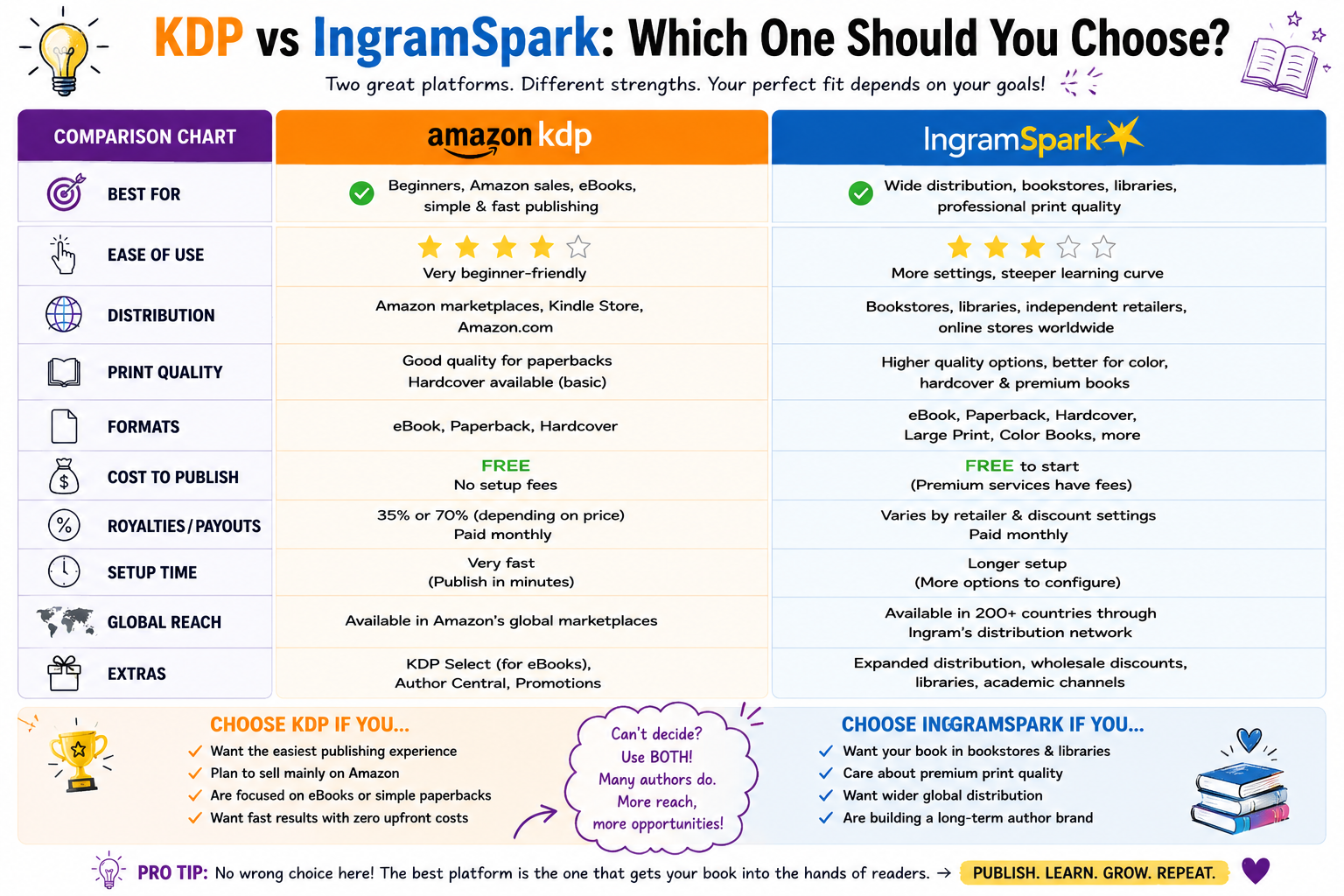
KDP is heavily centered around Amazon.
IngramSpark is centered around everywhere else.
If your dream is simply:
“I want readers to buy my book online”
then KDP may honestly be enough.
But if your dream includes:
seeing your book in bookstores,
making it accessible to libraries,
expanding into global retail systems,
then IngramSpark becomes extremely valuable.
Let’s Talk Print Quality Because Authors Absolutely Care About This
The print quality debate between KDP and IngramSpark is surprisingly intense online.
Some authors analyze paper texture like professional detectives.
Realistically?
Both platforms produce good-quality books.
But there are differences.
KDP works wonderfully for standard paperbacks and everyday publishing. The setup is easier, the printing is fast, and the quality is solid for most genres.
IngramSpark, however, is often preferred for:
premium hardcovers,
illustrated books,
photography books,
higher-end print finishes.
The color printing options and bookstore-style production quality can feel slightly more polished.
Here Comes the Part Everyone Pretends Not to Stress About: Royalties
Money.
The thing authors say is “not important” while secretly opening royalty calculators 14 times per week.
KDP keeps things fairly straightforward. Publishing is free, setup is simple, and royalties are beginner-friendly.
IngramSpark introduces more complexity because it operates within wider retail systems. There are wholesale discounts, return settings, print calculations, and expanded distribution structures to think about.
At first, it feels overwhelming.
Eventually, it starts making sense.
Mostly.
So Which Platform Is Better?
Honestly?
Neither platform is universally “better.”
They simply solve different problems.
If you want:
simplicity,
fast publishing,
Amazon visibility,
beginner-friendly setup,
KDP is fantastic.
If you want:
bookstore distribution,
library access,
premium publishing flexibility,
wider global reach,
IngramSpark becomes incredibly valuable.
And here is the plot twist many new authors do not realize:
You Can Use Both
A huge number of self-published authors combine them strategically.
They use:
KDP for Amazon sales
IngramSpark for expanded distribution
This allows them to maximize reach while still benefiting from Amazon’s visibility.
Basically:
“Why choose one source of publishing confusion when you can professionally manage two?”
Helpful Resources for Authors
Publishing Platforms
Formatting Tools
Cover Design
Author Organization
The Self-Publishing 360 Notion Author OS Template helps authors organize:
publishing checklists,
launch timelines,
editing stages,
writing progress,
marketing plans,
without turning your desktop into a chaotic jungle of random folders and unnamed PDFs.
Final Thoughts
Choosing a publishing platform can feel overwhelming at first because it feels permanent and important.
But remember:
your success as an author is not decided by one dashboard.
It is decided by consistency, learning, publishing, improving, and continuing forward.
KDP makes publishing accessible.
IngramSpark makes distribution wider.
And both platforms have helped thousands of authors successfully publish books readers love.
The important thing is not choosing the “perfect” platform.
The important thing is finally getting your book into the world.